
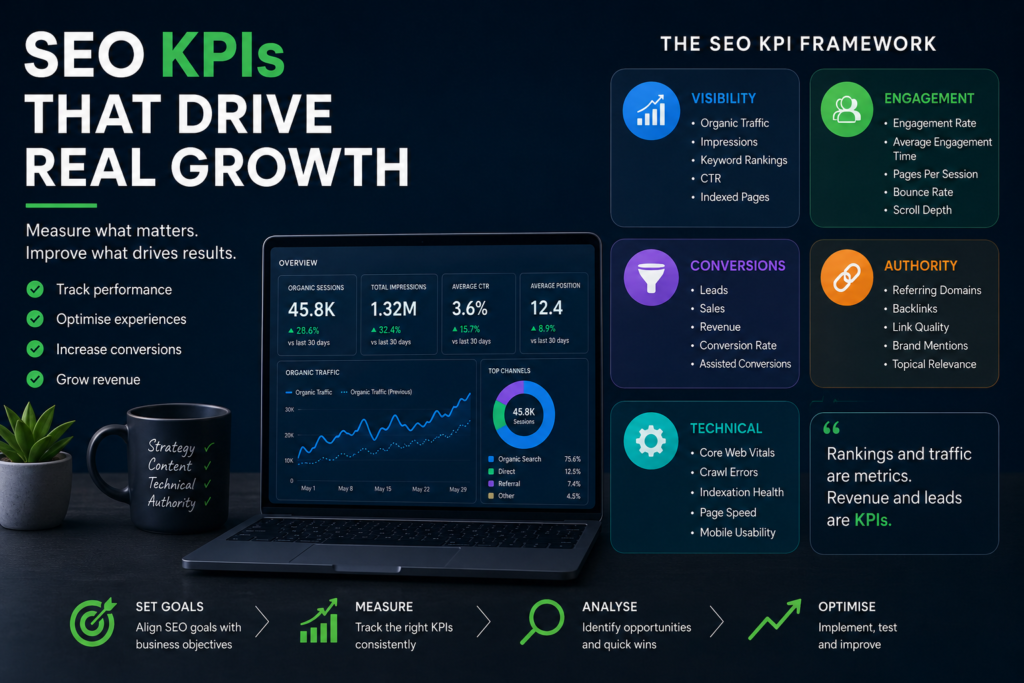
Many SEO reports still focus too heavily on rankings and traffic without connecting performance back to real business outcomes. While visibility metrics remain important, modern SEO measurement needs to go beyond vanity metrics and focus on how organic search contributes to leads, sales, engagement, and long-term business growth.
As search evolves through AI-driven search experiences, changing user behaviour, and increasingly competitive SERPs, understanding the right SEO KPIs is more important than ever.
This guide explains the SEO KPIs that actually matter in 2026, why they matter, and how businesses should track them.
Organic Traffic Still Matters
Organic traffic remains one of the most important SEO KPIs because it measures whether your website is gaining visibility in search engines.
An increase in organic traffic typically indicates:
stronger keyword visibility
improved indexing and crawlability
better content relevance
improved authority and trust
stronger internal linking and topical coverage
However, traffic alone should never be viewed in isolation.
A website can grow traffic significantly while generating very little commercial value if the wrong keywords are being targeted.
For this reason, organic traffic should always be analysed alongside:
conversions
user engagement
keyword intent
revenue attribution
Recommended Actions
Track year-on-year organic growth rather than relying only on month-to-month fluctuations
Separate branded and non-branded traffic
Segment informational and commercial landing pages
Monitor landing page trends individually rather than only sitewide traffic
Use Google Search Console and GA4 together for clearer visibility analysis
Rankings Are Directional Indicators, Not Success Metrics
Keyword rankings are useful, but they should not be treated as the ultimate measure of SEO success.
Rankings naturally fluctuate due to:
Algorithm updates
Location personalisation
Device differences
SERP features
Competitor movement
Ranking #1 for a low-intent keyword may generate little business value, while ranking #5 for a highly commercial keyword could generate substantial revenue.
Rather than obsessing over individual rankings, businesses should focus on broader keyword visibility trends.
Better Ranking Metrics to Track
Number of keywords in positions 1–3
Number of keywords in positions 4–10
Commercial keyword growth
Keyword visibility by page category
Topic cluster visibility
Share of voice against competitors
Recommended Actions
Track keyword groups rather than individual keywords
Prioritise commercially valuable terms
Analyse ranking movement alongside traffic and conversion changes
Improve pages ranking between positions 4–15 for faster gains
Align keyword targeting with search intent
Click-Through Rate Is Often Overlooked
Many websites lose significant traffic simply because their titles and meta descriptions are underperforming.
A page ranking well with a poor click-through rate often signals:
Weak title tags
Unclear messaging
Poor alignment with search intent
Lack of emotional triggers
Weak value proposition
Improving click-through rate can generate additional organic traffic without improving rankings.
This makes CTR optimisation one of the highest-leverage SEO activities available.
Recommended Actions
Identify high-impression pages with low CTR in Google Search Console
Rewrite title tags to improve clarity and search intent alignment
Use stronger calls to action where appropriate
Include trust signals, benefits, or differentiators
Test emotional language carefully without becoming clickbait
Conversion Metrics Are the Real SEO KPI
Traffic without conversions has limited business value.
Modern SEO reporting should focus heavily on how organic traffic contributes to:
Enquiries
Sales
Bookings
Phone calls
Lead generation
Newsletter signups
Revenue
This is where SEO becomes commercially meaningful.
Businesses increasingly want SEO tied directly to revenue impact rather than visibility metrics alone.
Recommended Actions
Configure GA4 conversion tracking correctly
Track form submissions and lead events
Assign estimated monetary values to conversions
Measure assisted conversions from organic traffic
Separate micro conversions from primary revenue-driving conversions
Build SEO reports around business outcomes rather than rankings alone
Engagement Metrics Help Diagnose Content Quality
Engagement metrics help identify whether users are finding pages useful after landing on them.
Poor engagement may indicate:
Weak content quality
Slow-loading pages
Intent mismatch
Poor UX
Confusing layouts
Weak internal linking
Lack of trust signals
Useful engagement metrics include:
Engagement rate
Average engagement time
Pages per session
Scroll depth
Return visits
While engagement metrics are not direct ranking factors in the traditional sense, they often correlate strongly with content quality and user satisfaction.
Recommended Actions
Improve page readability and structure
Reduce unnecessary page clutter
Improve internal linking pathways
Strengthen calls to action
Add supporting media where appropriate
Ensure content answers search intent quickly and clearly
Backlinks Still Matter
Despite ongoing debates within the SEO industry, backlinks remain a major ranking signal.
However, link quality matters far more than raw volume.
Modern link building should focus on:
Topical relevance
Editorial quality
Trusted websites
Crawlable links
Natural placements
Brand authority
Low-quality or manipulative link building introduces long-term risk.
Search engines continue becoming better at identifying artificial link patterns.
Recommended Actions
Focus on acquiring relevant editorial links
Audit low-quality backlinks periodically
Build links to important commercial pages
Improve internal linking alongside external authority building
Avoid over-reliance on DR metrics alone
Technical SEO KPIs Matter More Than Ever
Technical SEO issues can limit the effectiveness of otherwise strong content and link profiles.
Core areas to monitor include:
Crawlability
Indexation
Core Web Vitals
Mobile usability
JavaScript rendering
Structured data
Page speed
Poor technical implementation can prevent search engines from properly understanding and ranking content.
This is especially important on modern JavaScript-heavy websites.
Core Web Vitals To Monitor
Largest Contentful Paint (LCP)
Interaction to Next Paint (INP)
Cumulative Layout Shift (CLS)
Recommended Actions
Ensure critical content is server-rendered where possible
Reduce layout shifts and unstable elements
Optimise image delivery and compression
Minimise unused JavaScript
Improve caching policies and server response times
Regularly audit indexation and crawl health
SEO ROI Is the KPI That Executives Care About Most
Ultimately, businesses invest in SEO to generate commercial returns.
SEO ROI is therefore one of the most important long-term KPIs.
A simple formula is:
SEO ROI = (Revenue from SEO − SEO Cost) ÷ SEO Cost
This helps businesses understand:
Campaign profitability
Return on agency investment
Content marketing performance
Long-term acquisition efficiency
SEO contribution compared to paid channels
As competition increases, demonstrating SEO profitability becomes increasingly important for retaining stakeholder support.
Recommended Actions
Connect SEO reporting to revenue wherever possible
Estimate lead values for service-based businesses
Monitor customer acquisition costs from SEO
Compare SEO performance against paid channels
Focus investment on highest-performing page categories
Recommended SEO KPI Dashboard
A strong SEO dashboard should combine visibility, engagement, technical health, and business performance.
Visibility KPIs
Organic traffic
Impressions
Non-branded traffic
Keyword visibility
Indexed pages
SERP click-through rate
Engagement KPIs
Engagement rate
Average engagement time
Pages per session
Scroll depth
Returning visitors
Conversion KPIs
Leads
Revenue
Sales
Form submissions
Calls
Conversion rate
Assisted conversions
Technical SEO KPIs
Core Web Vitals
Crawl errors
Index coverage
Mobile usability
Site speed
Structured data health
Authority KPIs
Referring domains
Link relevance
Link quality
Brand mentions
Digital PR performance
Final Thoughts
SEO measurement has evolved significantly.
While rankings and traffic remain important indicators, they are no longer enough on their own.
The most effective SEO strategies in 2026 focus on:
Qualified traffic
Search intent alignment
User engagement
Conversion performance
Technical health
Business impact
The strongest SEO reporting frameworks connect organic visibility directly to commercial outcomes.
Businesses that understand this distinction are far more likely to build sustainable long-term organic growth.